

Quick Summary
The best fillet knife for professional chefs is one that holds a keen edge through full service, flexes along the spine without tearing flesh, and stays balanced over a long shift. Choose blade length by your most common fish: seven inches for small fish and detailed work, nine inches for large salmon and halibut.
- List the three fish you filleted most last month, then judge each knife by how it handles them.
- Seven-inch blades suit small fish and tight workspaces; nine-inch blades cover larger fish in fewer cuts.
- Stainless steel resists corrosion and needs less care, while high-carbon steel holds a finer edge but needs drying.
- Test grip security with wet hands, since a handle that feels fine when dry can turn slippery during filleting.
- Electric fillet knives suit high-volume breakdown, but a hand knife is still needed for precision finishing.
Table of Contents
- What Professional Chefs Need From a Fillet Knife
- Blade Length and Flexibility: Matching the Knife to the Fish
- Blade Steel, Edge Retention and Sharpening in Daily Service
- Handle Comfort, Grip and Fatigue Over a Long Shift
- Electric Fillet Knives: Where They Fit in a Professional Kitchen
- Cutting Fish Bones: Choosing a Knife and Technique for Pin Bones
- Choosing Your Professional Fillet Knife: Next Steps for Your Kitchen
- Frequently Asked Questions
What Professional Chefs Need From a Fillet Knife
Last Updated: November 2, 2026
Professional chefs need a fillet knife that stays sharp through a full service, feels balanced after hours of use, and cleans up quickly between tasks. Miracle Mist Inc. offers handmade marine-grade Damascus fillet knives, and the rest of this best fillet knife for professional chefs guide explains how to judge any option against that standard.
Start with the job. A kitchen that portions salmon all day needs different tools than a kitchen that breaks down whole flatfish once a week. Most buying mistakes happen because the buyer chooses by appearance or price, then discovers the knife is too stiff, too short, or too hard to keep sharp.
Our advice is simple: list the three fish you filleted most often last month, then judge every knife by how it handles those fish. That exercise narrows the field faster than any spec sheet.
A professional fillet knife should do four things well:
- Hold a keen edge through repeated daily use
- Flex enough to follow the spine without tearing the flesh
- Stay balanced and comfortable through a long shift
- Clean and dry quickly to meet food-safety standards
Blade Length and Flexibility: Matching the Knife to the Fish
Blade length and flexibility decide how well a fillet knife handles a given fish. A longer, more flexible blade suits large fish with long, smooth body cavities, while a shorter, stiffer blade gives better control on small or bony fish.
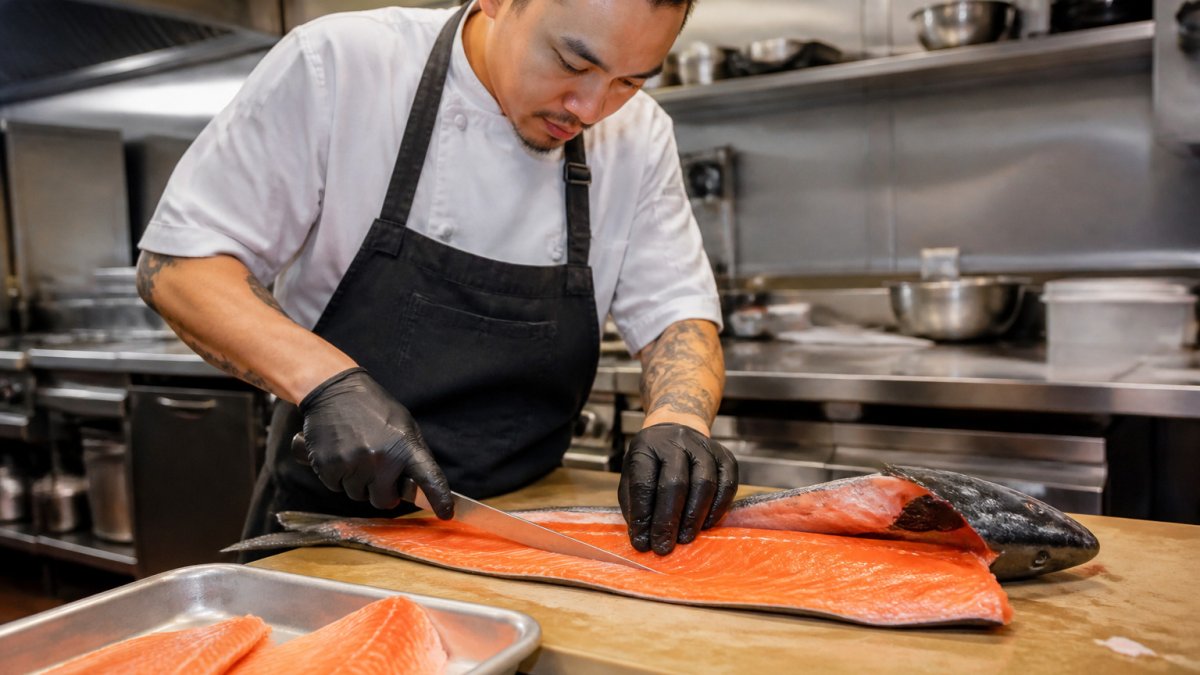
!A professional chef in a stainless steel commercial kitchen filleting a whole salmon on a cutting board with a flexible fillet knife
Most professional kitchens work with two common lengths. Seven-inch blades offer precision for trout and smaller species. Nine-inch blades cover larger salmon and halibut in fewer strokes.
Why 7-inch and 9-inch blades serve different kitchens
A 7-inch blade fits tight workspaces and small fish, and it gives more control at the tip. A 9-inch blade reaches across larger fish in one pass, which reduces the number of cuts and keeps the flesh intact. The 9-inch handmade Damascus fillet knife from Miracle Mist Inc. has a 9-inch blade, a 5-inch handle and a full tang, with all pins drilled and set through the handle.
Flexibility matters as much as length. A flexible blade bends along the spine and follows the contour of the fish. A stiff blade cuts straight and suits trimming and portioning. Many kitchens keep both types on hand.
Blade Steel, Edge Retention and Sharpening in Daily Service
Blade steel determines how long an edge lasts, how easily it sharpens, and how much care the knife needs between shifts. For a professional fillet knife, the practical question is not which steel is "best" in the abstract but which steel matches your volume, your fish, and the amount of maintenance your crew will actually do.
The three steel families you will encounter break down like this:
- High-carbon steel (often 1095 or a similar simple carbon alloy) takes a very keen edge quickly and sharpens easily on a stone. It also stains and rusts if left wet, so it demands drying and light oiling after every service.
- Stainless steel (common kitchen alloys include 440C, VG-10, and similar grades) resists corrosion and holds a working edge through a full prep session with less babysitting. It is harder to sharpen to a fine edge than simple carbon steel but far more forgiving in a wet commercial kitchen.
- Layered or Damascus construction sandwiches a hard core between softer outer layers. The hard core supports edge retention while the softer cladding adds toughness and corrosion resistance. The visible pattern is cosmetic; the performance comes from the core alloy and the heat treatment, not the layer count.
A useful rule of thumb from working bladesmiths: harder steels (roughly the high-50s to low-60s on the Rockwell C scale) hold an edge longer but chip more readily if you torque the blade against bone, while softer steels (mid-50s) roll and dull faster but straighten easily with a steel or ceramic hone. A fillet knife that will be flexed around ribs and spines benefits from enough toughness to survive that motion without micro-chipping.
Edge retention in daily service depends as much on technique as on alloy. Most practitioners find that a fillet knife used for several hours of salmon portioning needs a few light passes on a fine hone or ceramic rod during service and a full sharpening on stones every week or two, depending on volume. Waiting until the blade tears flesh is too late: a dull fillet knife crushes the cut surface, shortens shelf life, and wastes yield on every fish.
Sharpening angles matter for fillet work. A relatively acute edge (roughly 15 degrees per side) slices cleanly through delicate flesh, while a slightly wider angle (around 20 degrees per side) survives contact with pin bones and ribs better. Many chefs keep a dedicated fillet knife at the acute angle and accept more frequent honing in exchange for cleaner cuts.
Watch out: layered and high-carbon blades left in a wet sink or a closed sheath will stain, pit, or develop rust at the edge; dry the blade fully and store it outside the sheath so moisture does not sit against the steel.
For a commercial kitchen, the practical maintenance routine is: wipe and dry after every task, hone lightly during service, sharpen fully between shifts or weekly depending on volume, and oil carbon or layered blades that will sit unused. That routine, more than the steel name on the box, is what keeps a fillet knife cutting cleanly through a full service.
The table below sums up the three steel families and how each one handles daily kitchen use.
| Steel type | Main strength | Main drawback |
|---|---|---|
| High-carbon steel | Takes a very keen edge and sharpens easily | Stains and rusts if left wet |
| Stainless steel | Resists corrosion, forgiving in wet kitchens | Harder to sharpen to a fine edge |
| Layered or Damascus construction | Hard core for edge retention, softer cladding for toughness | Visible pattern is cosmetic; performance comes from the core alloy |
Handle Comfort, Grip and Fatigue Over a Long Shift
Handle ergonomics is where most fillet-knife buying advice stops at "it feels good in the hand," and that is exactly where a professional kitchen needs more. Over a long prep session, small differences in grip security, weight distribution, and handle shape compound into hand, wrist, and forearm fatigue, and fatigue shows up as sloppier cuts and more waste.
The first thing to evaluate is grip security under wet conditions. Filleting involves slippery hands, wet cutting boards, and constant wiping. A handle that is secure when dry but slick when wet is a liability. Look for textured or contoured surfaces, a palm swell that fills the hand, and a shape that resists rolling when your grip loosens. Many practitioners find that a slightly oval or contoured handle indexes better in the hand than a perfectly round one, because the hand can feel the orientation of the edge without looking.
Damascus pocket knive with wooden handle and sheath →
Handle material is a trade-off, not a ranking:
- Wood (including stabilized and oiled hardwoods) offers warmth, a naturally tacky feel when slightly damp, and good shock absorption. It requires dry storage and occasional oiling; prolonged soaking or dishwasher exposure will swell, crack, or warp it.
- Synthetic materials (such as textured polymer or fiber-reinforced composites) are impervious to water, easy to sanitize, and dimensionally stable. They can feel slicker when wet and may transmit more vibration into the hand.
- Full-tang construction, where the steel extends through the handle, generally improves balance and durability, but it also adds weight and can transmit cold and vibration. A partial tang or encapsulated tang can shift balance toward the blade, which some chefs prefer for long slicing strokes and others find tiring.
Balance is the second factor. A fillet knife should feel neutral or slightly handle-heavy in a pinch grip, so the tip stays controllable during long, flexible strokes along the spine. A blade-heavy knife encourages the wrist to do more work to keep the tip up, which is a common source of fatigue during extended filleting.
Weight matters too. Lighter knives reduce fatigue over hundreds of cuts, but too light a blade can feel vague and force a tighter grip. The goal is a knife that lets you relax your grip between strokes rather than one you have to squeeze to control.
Finally, test the motion, not just the static feel. Simulate the actual stroke you use on the line, long flexible draws for salmon, short controlled cuts for smaller fish, and notice whether your grip stays relaxed or tightens as you go. A handle that feels fine for ten seconds can reveal its flaws after a hundred cuts.
Watch out: a handle that fits perfectly in a dry showroom can become unsafe when wet and greasy; test grip security with wet hands before committing a knife to daily service.
Electric Fillet Knives: Where They Fit in a Professional Kitchen
Electric fillet knives use a reciprocating blade to cut through bone and flesh with less hand strain. They suit high-volume tasks, but they do not replace a hand knife for precision work.
Many professional kitchens use an electric knife for breaking down large quantities and a hand-held fillet knife for finishing. Electric models require careful cleaning and blade replacement, so factor that maintenance into your budget.
Cutting Fish Bones: Choosing a Knife and Technique for Pin Bones
Pin bones are the small bones running along the center of a fillet. Removing them cleanly requires a knife with enough flexibility to lift the flesh without tearing it, plus a steady technique.
The Something's Fishy Damascus gutting knife has a hook and comes with a leather sheath with belt loop. For pin bones, a flexible fillet knife usually gives cleaner results. Use tweezers to pull bones out after the knife has loosened them.
A common mistake is pressing too hard. Let the blade do the work and keep strokes short and controlled.
Choosing Your Professional Fillet Knife: Next Steps for Your Kitchen
Your next step is to match a knife to your three most common fish and your kitchen's daily volume. If you process large salmon regularly, look at a 9-inch flexible blade. For smaller fish and tight prep areas, a 7-inch blade gives better control.
Explore the Stainless Steel Damascus fillet knife bone handled with Dorado for a handmade 9-inch option with a full tang, or see the Something's Fishy Damascus gutting knife with leather sheath for a hook-equipped option with a leather sheath.

Frequently Asked Questions
What blade length is best for professional fillet work? Seven-inch blades suit small fish and detailed work. Nine-inch blades handle larger fish such as salmon and halibut in fewer cuts.
Is stainless steel or high-carbon steel better for a professional kitchen? Stainless steel resists corrosion and needs less care. High-carbon steel holds a finer edge but needs more maintenance to prevent staining.
Do electric fillet knives replace hand knives? No. Electric knives suit high-volume breakdown, while hand knives offer the precision needed for finishing and pin bones.
Frequently Asked Questions
What fillet knife do professionals use?
Most professional kitchens reach for a flexible blade between 7 and 9 inches long, because it bends around the rib cage and follows the contours of the fish while keeping the cut clean. Many chefs also keep a stiffer boning knife nearby for heavier work. Check the blade steel, handle material and sharpening needs before buying, since those determine how well a knife performs across a full service.
Should I get a 7-inch or 9-inch fillet knife?
A 7-inch fillet knife suits smaller fish, trout, and tighter prep spaces, and it is easier to control for long shifts of portioning. A 9-inch blade handles larger fish such as salmon or whole halibut more efficiently, since each pass covers more length. Many professional kitchens buy both sizes so each task has the right tool. If you can only buy one, match the length to the fish you process most often, not the size that looks most impressive on the shelf.
Is a flexible or stiff fillet knife better for professionals?
A flexible blade is generally better for skinning and filleting delicate fish, because it bends along the body and removes flesh with less waste. A stiffer blade offers more control when working through thicker bone or larger cuts. Most chefs choose flexibility as the primary characteristic for fish, then keep a stiffer knife for other tasks. Test the blade in your hand before you buy, and pay attention to how it responds to pressure during simulated cuts.
What is the best knife for cutting fish bones?
Pin bones are usually removed with tweezers or a dedicated pin bone tool, while a fillet knife is used to separate flesh from the bone structure. For the bone-cutting step itself, a sturdy, narrow-tipped knife with a stiffer blade gives better control than a thin flexible one. Keep the blade sharp, since dull edges tear flesh and slip more easily around bone. Professional kitchens often pair a fillet knife with a separate boning knife for this work.
